Learning at Work Week, by Tamsin Parker

My relationship with driving is pretty similar to my relationship with exercise – I do it because I have to not because I have any massive desire to want to do it.

I’m not going to lie; I wasn’t a natural driver – it took me a while to click with it. In fact, I failed my first test for forgetting to put my seatbelt on I was that nervous – instant fail!

Anyway, I’ve been driving for a long time now and my parking’s still no better so when Adrian suggested I did one of his courses to mark Learning at Work Week, I thought why not?

We go back a long way – we both worked for Staffordshire County Council where Adrian led the Road Safety Team and I worked in PR. I media trained him and he took me out on a Road Safety Awareness course, for an article I was writing for a staff magazine. The long and short of it is I knew I was in safe hands.

So, I have road tested his Eco Safety course (sorry I know that’s a dreadful pun) – It’s a 90-minute virtual training session, broken down into modules so you can fit it in to your own timescale (useful when you’re juggling kids and work).

I’ve been driving since the late 90’s so I guess it becomes second nature, but you do wonder if after that amount of time you’ve picked up habits that you shouldn’t have along the way

Adrian’s course is incredibly well put together, he’s a great presenter (obviously my media training has stayed with him all these years, ha ha), there’s video commentary, exercises, as well as information and tips that are really useful. He covers off areas from driving on rural roads and motorways, to coping with hazards and something called COAST which you’ll learn about if you go on his course. If you live in Staffordshire you also get to play spot the area in some of the footage (or that could just be me.)

Who knew the speed limit for a van is different than a car or that dual carriageways aren’t determined by the number of lanes?

On a serious note – more than a quarter of accidents involve driving for work at the time of the accident. That’s scary so if you have staff that drive, this course is a no brainer.

It’s obviously designed to help you drive more safely but it also gives you tips on fuel efficiency and what employer doesn’t want to save money? I’ve challenged myself to carry out some of the suggestions to try and use less fuel!

Adrian’s clearly an expert in his field, his course is so insightful and he’s an excellent trainer but then he did start out as a driving instructor. What’s more, if you are a Staffordshire based business you would qualify for funding of 48% through the Stoke on Trent & Staffordshire Skills Hub. You might even qualify for 100% funding if you pay your business rates to a Staffordshire Local Authority other than the City of Stoke on Trent. Ask Adrian for details.

Back to me now and don’t get me wrong there are some benefits to being one of the world’s worst at parking – you always find your car straight away when you come out of Tesco (I just look for the car that’s parked the most badly) but I do wonder if I should get Adrian to give me some parking lessons. 

You’re never too old to learn – every day’s a school day, especially during Learning at Work Week.

World day for safety and health at work

We are supporting this important day by urging businesses to think about their driving for work activities – are they part of your overall health and safety management?

Could you afford to pay £750,000 in fines and costs because you’d failed to ensure the health and safety of your drivers?

That figure was the reality for one company last year, after two of their drivers were tragically killed back in 2013. The company were found guilty of health and safety breaches.

You might be under the illusion that health and safety merely relates to what you do as a company to keep your staff and customers safe on site. You’d be wrong.

If you employ more than five people and your staff drive as part of their job, it’s your job to make sure they’re as safe as they possibly can be.

Essentially that means If you drive as part of your job, your workplace becomes your vehicle, and your vehicle a piece of work equipment, and it doesn’t matter who owns it.

More than a quarter of accidents involve people who are driving as part of their employment – that’s a lot of accidents that could have potentially been prevented, with the right training.

In the absolute extreme, if you fail in your duty of care to protect your employees whilst they’re on the road, you as a business owner, or managing director, could face a corporate manslaughter charge, under health and safety legislation.

You could also face fines equating to 20% of your turnover. It doesn’t matter if your company is large or small – a fifth of your turnover is a lot. More sobering though is this thought – if one of your employees was driving for work and they were killed on the road, how would you feel if under investigation, your company hadn’t given that driver the right training to help keep them safe. Would you want that on your conscience?

If this sounds scary and you weren’t aware of your responsibilities as an employer, the Health & Safety Executive (HSE) has published a document called ‘Driving at Work – managing work-related road safety,’ which will help. Check out the link for more information: Click Here

We’ve also developed a 60 second survey to help you determine whether you’re doing enough to manage driver safety. The simple survey only has six questions – you know you’re doing everything right if you answer yes to every single question. Conversely if you answer no to any one of them, you could be leaving your drivers and your company vulnerable. To take our survey Click Here

Driving Home the Road Safety Message for Education and Outdoor Activity Provider

Background

Audley based Peak have four registered independent day schools in Cannock, Gailey, Stoke-on-Trent and Audley.  Along with six activity water sports and activity centres in the Cheshire, Staffordshire and South Yorkshire. The company ethos is Education through Adventure. 

Challenges faced

Peak have more than 160 staff who drive as part of their work, the majority of which are classed as young drivers (aged 17 to 24). Their staff transport up to 100 pupils a day to and from the various locations along with towing trailers including 6m mobile climbing walls!

Health and Safety Executive and Department of Transport figures show:

  • Nearly three in ten collisions involve a young driver aged 17 to 24
  • One in five new drivers will have an accident within their first year of driving
  • More than a quarter of accidents will involve someone driving for work at the time of the incident

Requirement

Peak Transport Manager Andy Foster wanted a virtual road safety course creating that could be delivered on-line so their drivers could fit the training in, in and around their working day.

How we helped

Adrian took his e-Learning based Eco-Safe driving course and customised it to include the company logo, a personal company message in the form of a video supplied my Peak, a module specifically for young drivers because of their team’s demographic as well as downloadable personal action plans and Peak’s vehicle safety check form.

On the date specified by Peak, over 160 staff were enrolled onto the course with regular reports provided so that course participation and completion could be monitored.

What our client said

Peak Education’s Andy Foster said: “Road safety is of paramount importance to us not just for the students we transport but for our drivers too. I really feel that it’s out duty to ensure our drivers are as skilled as possible. We have a very young workforce and because we know that statistically you’re more likely to have an accident when you’re younger we want to make sure we give our drivers the best training possible.

“I’ve been looking for a virtual course for our staff to go on for a while when I came across Adrian’s work. He has been absolutely fantastic. He designed something specifically for us and nothing has been too much trouble. The feedback we’ve had from the drivers who have already completed the course has been brilliant. They’ve told us they already feel far more aware and are putting into practice the things they’ve learnt. We will carry on working with Adrian to deliver our training and have made his course part of our mandatory training for all new starters.”

Lauryn Winter, 18, Apprentice Inclusive Education Practitioner said: “The course has really opened my eyes. I’m not the most experienced driver yet but I honestly thought I knew what I needed to know to make sure I was as safe as possible. Adrian’s course has really opened my eyes, not only just about safety but about fuel saving and your carbon footprint. I’ve learnt lots and it was enjoyable too.”

Safer Van Driving e-Learning course launched

When we entered lockdown, like many others, I could not help but worry about my businesses future and who would have thought that it would have gone on so long too. Being a half-glass full kind of guy, I knew I needed to think outside the box and figure out how I can adapt my business to the ‘new normal’, a phrase that has become commonplace now.

While I specialise in helping businesses embed a safe driving culture into the workplace, that is to have the right governance around policies, practices and procedures, my background stems from 30 plus years as a driver trainer.

I’m a great advocate of in-vehicle and in-class training, however, it can be disruptive on people’s day and costly too, now with COVID-19 not wanting to go away any time soon, face-to-face training is probably best avoided. This made me think, we are all getting so used to remote working and harnessing technology, my training needs to head in that direction too.

I invested in a Learning & Development platform and a home video studio, then set about planning a suite of courses. I got an interesting prompt to create a Safer Van Driving course as my first, after accepting a delivery for some equipment via home delivery courier.

The bell rang, I answered the door to be greeted, at a distance, by someone I knew, but, instead of working in his usual place, he is now delivering parcels for a courier.

I naturally asked whether he had been given any formal training on driving a van, the answer was no. I then asked whether he had driven a van before, the answer again was no. My next question was to ascertain whether he knew that when on national speed limit roads, the speed limits for vans are different to cars, he didn’t know that nor did he know about how to not overload a van or where to find the VIN plate which contains important weight information. Now this sounds like I’m being a bit harsh on the poor old guy, I’m not, why would this guy know this stuff anyway, if he’s never driven a van before or his employer hasn’t offered any guidance or training, it’s not surprising to get a lot of no’s.

This made me think, there has been an explosion in the home delivery sector, not just in the courier business, but businesses finding for the first time a need to get their goods to their customers themselves, in a van. This means that unless they are aware of the key difference in driving a van, compared to a car, drivers may well very easily find themselves on the wrong side of the law. If something really bad happens, the business could be culpable for not ensuring their drivers were appropriately trained.

So, as I’m sure you will agree, a Safer Van Driving course was a natural first for me to develop. After a considerable amount of planning, preparation, filming, editing and course setup, I’ve finally completed and published my first e-Learning course.

The beauty of e-learning is that it’s the least disruptive type of training we can do, you can work your way through the modules at your own pace and in my course, which has just over 100 minutes of content, it is sub-divided into eight bite-sized modules.

The learning outcomes are: Participants completing this course will be able to demonstrate an understanding of:

  • Legal aspects of driving a van
  • What is or is not a car-derived van
  • How to conduct a vehicle safety check
  • Loading and unloading, including carrying capability of the van and understanding the VIN plate
  • Effective speed management
  • Personal safety
  • Safe and fuel-efficient driving
  • Defensive driving techniques

While the course has first-time van driver in mind, for the more seasoned van driver, especially if they’ve not had any formal training, this course is a great refresher of knowledge. For businesses, it’s a cost-effective way of demonstrating due diligence in that they have offered their drivers appropriate training.

The course culminates in a quiz, this is a great way of highlighting the key learning points and is the final stage before participants download their Certificate of Professional Development, proof that they have completed the course.

I’m proud to announce also that I am now an Approved Training Provider with the Stoke on Trent & Staffordshire Skills Hub. This means that for businesses or individuals based in Staffordshire, 48% of the total cost of training can be reclaimed via a grant. This makes the training exceptional value for businesses with no more than 250 employees.

So, I entered lockdown with uncertainty, but I’m emerging with a new opportunity to grow my business and look after the road safety needs of businesses, something that I love doing.

You can’t manage the risks you don’t know about!

No one would disagree, we are living in extremely challenging times as the Coronavirus disrupts family and businesses life in a way we’ve never seen before, and hopefully never will again, however, we will come through this and get back to normal, that’s what we as a nation are good at. When we do, we will likely see a different kind of normal, however, some things will remain the same, unfortunately, I’m referring to road traffic collisions. As we bounce back our roads once again will be busy and more than ever, we need to think about how as caring businesses we can keep staff safe as they drive around our road network.

In a previous news article, I spoke about the need for businesses to think about taking responsibility for road safety, at least for the staff they have who drive as part of their work. To do this, a business needs to embrace driver safety and make it part of the businesses DNA, however,  there are several components that make up a good driver risk management programme, so over a series of articles I’d like to discuss these components, starting with a risk assessment.

Most businesses want to operate in a safe and legal manner and the last thing they want is to have one of their staff injured or killed as a result of the work activity they undertake. Take engineering for example, in a typical workshop there will be numerous pieces of equipment that can, if not used correctly, cause harm. On a construction site, the dangers are ever more present, and if you were involved in offshore gas or oil exploration, the working environment can be hostile and very dangerous. All these environments have their own risk factors; however, the businesses health and safety regime usually safeguards workers against the known risks.  Therefore, the process of good risk management for these and most other businesses starts with a risk assessment, this seeks to identify the risks so that measures can be put in place to mitigate the risks. If everyone then sticks to the rules and given that they are working in a controlled environment, injuries and fatalities should be few and far between. Unfortunately, accidents do happen, even with the most robust of health and safety controls, but lessons learned should seek to prevent a similar incident from occurring again.

I’d like to focus on one work-activity, one that most of us engage in to a more or lesser degree, that’s driving. In my experience, I find the management of driver risk is the poor relation to a business’s overall health and safety regime, in fact, far too many businesses do not consider driving an activity that is risky and therefore miss it out completely from their business risk assessment process.

Let’s look at some stats, according to the Department for Transport, over a quarter of the fatalities that happen on our roads involve someone who at the time of the incident, was driving as part of their work. This equates to a shocking five people per day on average die in a work-related driving incident!

The big problem is that such occurrences, as bad as they are, have little impact on us unless it happens to us or one of our family or friends, we’ve become anesthetized to the problem of deaths on the road, momentarily thinking, ‘that’s terrible’ and then going about our daily lives. There seems to be an almost acceptance that collisions, injuries and deaths are inevitable.

So, here’s a thing, 95% of collisions have driver error as the main contributory factor, in my world, driver risk management, I think this is a good thing, why, because we have an opportunity to influence change for the better. Imagine if 95% of collisions were as a result of mechanical failure! Would we trust our vehicles, probably not!

Going back to the point I made earlier, over a quarter of road-related fatalities involve someone driving as part of their work, so what can businesses do to protect staff and in doing so, meet their obligations under the Health & Safety at work act?

Good driver risk management starts with a risk assessment, this should ideally be a stand-alone risk assessment, not a few lines in your businesses generic risk assessment. Driving is a business’s single biggest risk; it warrants its own comprehensive risk assessment. When I produce a risk assessment for a typical non-complicated business, there are around twenty identified risks that we aim to address, for some businesses, there will be many more.

If your business is large enough to have a Health & Safety manager, he or she will be more than capable of conducting a driver risk assessment, however, for many small businesses they are often left to their own devices, so, I’d like to shed a bit of light onto the subject of conducting a risk assessment for your driving activities.

The idea behind a risk assessment is to identify a risk, what it is, why it may occur, who could be harmed and how, then what you believe you can do to limit, lower or remove the risk. As part of this process you should engage staff from the outset, they may identify issues that need to be included in your Risk Assessment that you might not have thought of!

Let’s look at the headings of a risk assessment in a little more detail:

What are the hazards? This is a description of what we consider the hazards are. A hazard is anything that puts the business, the driver or any other persons at risk. Some risks might be unique to your business, your staff, the vehicles they drive or the journeys they undertake.

Who might be harmed and how? This element seeks to identify who could be harmed if something were to go wrong. It could be the business, reputation, fines etc or the driver, their passengers or anyone else they meet while out driving. Consider everything and always look at a ‘worst case scenario’

What are you already doing to control the risks? This is where you need to be honest with yourself because unless you already have a robust driver safety programme in place, it’s possible that you won’t have many control measures in place. Make a list of what you are currently doing to manage and mitigate the risks you’ve identified. Remember, be honest, put ‘nothing’ if this is the current status quo, you can address this in the next section.

What further action do you need to take to control the risks? Once you have established what controls measures you have in place, you need to think about what else you could do. This might be to better monitor the existing control measures or perhaps add new controls as part of your lessons learned process. If you have entered ‘nothing’ in the above section, think what needs to be in place to eradicate, control  or mitigate the risk.

Who needs to carry out the action? This needs to be named individuals, with a single person taking overall responsibility for the risk assessment.

When is the action needed by? You must set realistic dates for the completion of any identified actions. Make sure all actions are done, never assume they will be!

Once you have your risk assessment in place you are in a much better position to manage the risks faced by your staff when they hit the road. The next step is to produce a driver safety policy, but I’ll talk about this in a future article.

What should we do once we’ve produced our risk assessment? Share it with your staff, ask for feedback and use lessons learned from any incidents to update the risk assessment. Review it annually, more frequently if your business is going through significant change.

Remember, safety is everyone’s responsibility, but you as the business leads must set the framework from which others will work towards, a risk assessment is therefore business critical document.
It’s the law!

Did you know, employers have duties under health and safety legislation for their on-the-road work activities. The Health & Safety at Work Act 1974 (HSW Act 2) states, “You must ensure, so far as reasonably practicable, the health and safety of all employees while at work. You must also ensure that others are not put at risk by your work-related driving activities”. That’s not me saying this, it’s the Health & Safety Executive!

In my experience, driver safety is sadly the poor relation of health and safety in the workplace, often because driving is not viewed as being a risky activity, after all, we all do it. But remember, over a quarter of collisions happen in work’s time, on a work’s journey, so as a responsible employer and one who puts people first, managing driver safety is a must and is a legal obligation too.

Now, here comes the challenge. We want to manage driver risk effectively in the workplace, what do we have to do? How do we do it? Who will do it? So many questions. Let’s explore this in a bit more detail.

Firstly, the mandate must come from the top for two reasons. Firstly the ‘controlling mind’, CEO, MD, business owner, etc., of the company has the authority to introduce practices to manage driver risk and secondly, should a fatality be a result of a work-related RTC, and the company were found guilty of failing in their duty of care, the charge is likely to be Corporate Manslaughter, which almost always results in a custodial sentence. It’s the controlling mind of the company who will face these charges. Incidentally, if a company were to suffer a significant incident, not resulting in a fatality, there is a lesser charge but one that will hit the bottom-line greatly; a fine based on a percentage of the company’s turnover!

So, the controlling mind, gives the mandate required, what then?

Someone needs to take responsibility for driver safety in the business, on behalf of, but supported by, the senior management team. Here are a few of the essential things you need to consider:

  • Records. A system to record all your drivers, the vehicles they drive and everything else that makes up good Driver Risk Management, RTC reporting, training, etc. Here’s a question for you, do you know exactly who drives in your business, even if it’s just an occasional trip?

  • Fitness to drive. Often taken for granted by both drivers and employers. If driving is a significant part of a person’s working day, then you should really engage the services of an Occupational Health professional to carry our driver fitness screening. You’d be amazed to learn just how many drivers have an undiagnosed and unreported DVLA notifiable medical condition.

  • A Risk Assessment. Specifically written for all on-road driving activities.

  • A Driver Safety Policy. More than a one-pager, this needs to be a comprehensive document articulating standards, expectations and control measures to mitigate risk, especially those identified through the Risk Assessment. Do you have one, would it stand up to scrutiny, is it well communicated to staff?

  • Licence checking. Extremely important as since the abolition of the paper counterpart, we no longer know what the driver’s history is, they might be banned, would you know? The only sure way is to conduct a GDPR compliant licence check – do you know how to do this?

  • Driver risk profiling. What we mean by this is that, statistically, a handful of your drivers, may be high risk. You need to identify who they are, why they are high risk and put measure in place to mitigate the risks.

  • Grey fleet management. This is an industry term for people who use their own vehicle for work purposes, not the commute, but driving as part of their work. The law makes no distinction between company vehicles or employee’s own vehicles. You have a duty of care to ensure the vehicle is fit for purpose, serviced in accordance with the manufacturer’s recommendations, is taxed, has an MOT if it needs one and that the driver has business cover on their insurance, you’d be amazed how many don’t!

  • Training. This can be in-class or on-road training and should also include the training of Line Managers. Do your Line Managers know what their responsibilities are for helping the company manage driver risk? After all, they are the people who have direct contact with your driving population. Training should be based on a needs analysis, this way it can be targeted to those that need it and the training tailored to an individual’s needs.

  • Ongoing Driver Risk Management. This is basically bringing your Driver Risk Management programme to life, making driver safety part of the company’s DNA. It involves senior management discussing incidents, lessons learned and to achieve zero harm in the workplace, through an effective communication plan. Most important of all, your programme should be reviewed annually, as a minimum, more frequently if your business is going through significant change or growth.

As you will see, managing driver risk in the workplace is quite an undertaking, but then again, it should be, we owe it to staff, after all, they are a company’s greatest asset and deserve to be kept safe.

Driving Safely in the wet

We’ve had a lot of rain lately and more on the way, this makes driving challenging at best, dangerous at worst. I suppose the advice must be, if the weather is really bad, consider not driving, however, this may not be a practical option I know.

Driving through flood water comes with some potential pitfalls, an innocent puddle at the side of the road could be harbouring a deep pothole, so, if you can and it is safe, set a steady course to avoid the puddle, pedestrians will love you for this too.

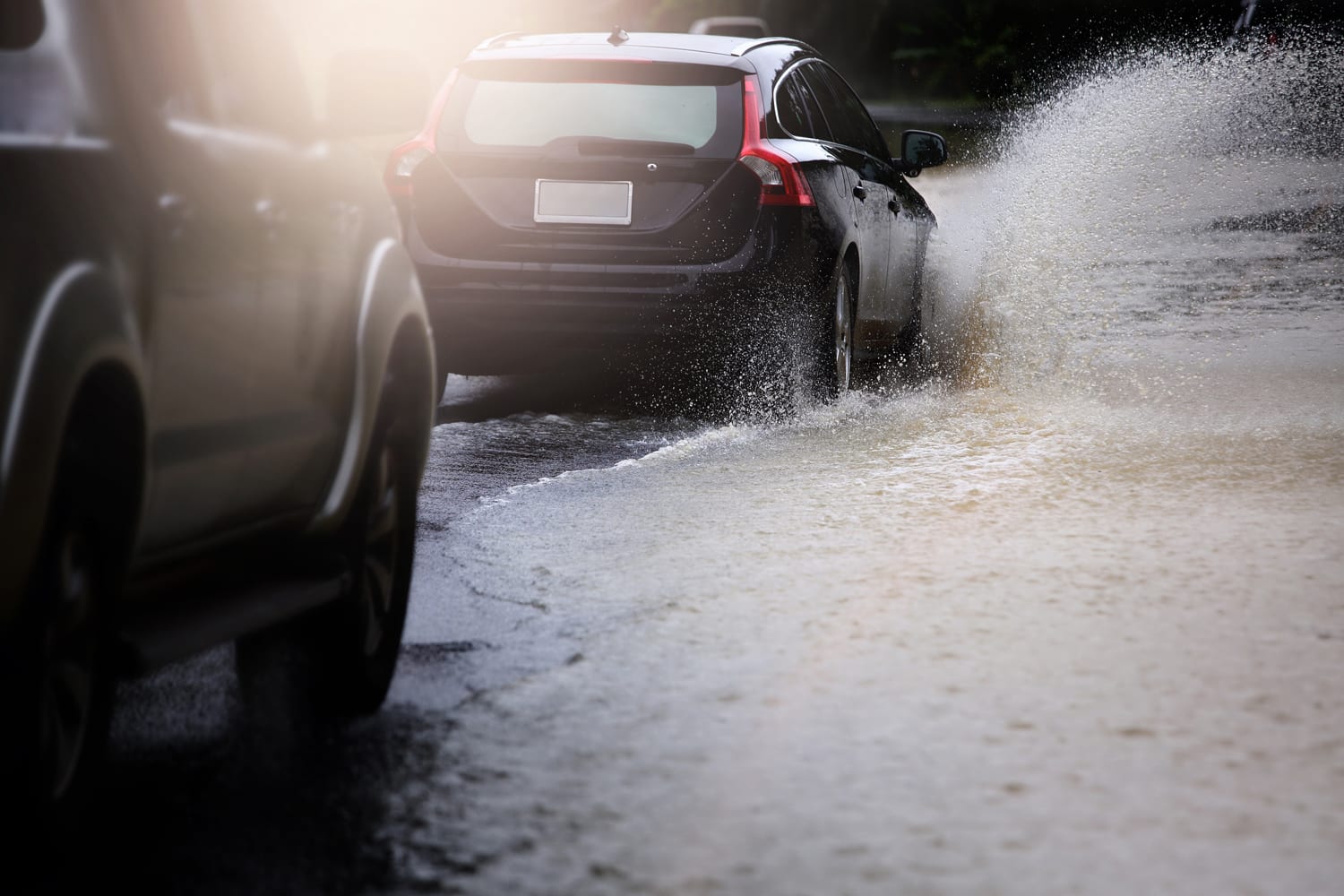
If you do have to drive through deep surface water, don’t drive like the people in the image I’ve attached to this article, this just forms a massive bow-wave ahead of you which can gain enough height to swamp your engine! Also, look at the water being dispelled sideways and away from your vehicle, the tyres are doing the same with the water on the inside, instead, it’s jet-washing your engine bay, not good!

The best way to drive through a flood is slowly and if you can, drive in the centre of the road where the water is likely to be at it’s shallowest. This will of course require you to look and plan well ahead. Maintain a speed that will not cause a bow-wave or excessive sideways waterfalls! Remember though, you may know what to do, but does the oncoming driver, so be careful how and where you chose to position your vehicle.

Once through the flood, test your brakes as soon as you can, but do this carefully, mirrors first, then apply light and progressive pressure on your brake pedal with you left foot while still driving along, this will feel strange and be careful, you might unintentionally brake hard, not good if there is someone close behind and you hadn’t checked your mirrors. Using this technique will force any water from your brake pads.

If you suspect the water level is above your exhaust tailpipe, best to NOT attempt to drive through.

Keeping your speed down when driving on very wet roads is always a good idea, especially if your tyres are heading towards their end of life, because low tyre tread, wet roads and speed can result in aquaplaning, this is where your tyres rise onto the surface of the water rather than remaining in contact with the road. You’ll know when this happens, the steering will become light and unresponsive. There is only one remedy, ease off the gas but definitely, definitely don’t brake!

And finally, contrary to popular belief, tyre tread is not for grip, it’s to remove water from under the tyre so that the rubber that is in contact with the road will grip the surface.

Did you know,  at 70mph, four new tyres could be pumping three gallons (13.4litres) of water every second. Reduced tread = reduced water dispersal, so, go check your tyres as soon as possible.

And finally, finally, do you remember the two-second rule, for keeping a safe distance? 2 second gap between you and the vehicle in front on a dry road, saying ‘only a fool breaks the two second rule’ (takes about to seconds) and adding ‘when the weather’s poor, add a bit more’ takes another two seconds, giving you your 4 second gap, because stopping distances double in the wet. However, these are minimums, I like to keep a lot more distance, I feel much safer and far more relaxed, how about you?

Driving for work – A businesses single biggest risk

Driving is a high-risk activity and likely to be a businesses single biggest risk, yet many do not manage driver safety as well as they should…

Drivers tailgating to blame for 1 in 8 serious collisions

Alarmingly, one in eight serious collisions on motorways is caused by drivers travelling too close to the vehicle in front, ‘tailgating’…

Daytime Running Lights may not be enough

New research has found that some drivers across the UK could be causing danger for other road users by relying on daytime running lights (DRLs) for illumination…

Get in touch

Together, we can make the roads safer for everyone

Call us on 07973 337 251
Email us at hello@adrianhideconsultancy.co.uk

Safer Driving Academy is the training division of Adrian Hide Consultancy

Get in touch

Together, we can make the roads safer for everyone

Call us on 07973 337 251
Email us at hello@adrianhideconsultancy.co.uk

Contact us Privacy Policy

Safer Driving Academy is the training division of Adrian Hide Consultancy

© Copyright Adrian Hide Consultancy | Safer Driving Academy is the training division of Adrian Hide Consultancy | Website by Clyq

Contact us Privacy Policy

© Copyright Adrian Hide Consultancy | Safer Driving Academy is the training division of Adrian Hide Consultancy | Website by Clyq