Ringing in the Changes with New Mobile Phone Law

This year has already seen big changes in the Highway Code (check out our blog – if you missed it) and now there’s set to be changes to the mobile phone law too.

Come 25th March, the law tightens up on those drivers who use their phones to video, text, access music or anything else that sees them messing with their phone while behind the wheel.

But what do the changes mean as it was already illegal to text or make a phone call using a handheld devise – (unless in an emergency?)

Essentially anyone caught using a hand-held device for any purpose at all (including taking photos or videos, scrolling through playlists etc), whilst behind the wheel will face a £200 fixed penalty notice and six points on their licence. You can also lose your licence if you passed your driving test in the last two years.

The only time you can use a handheld device is if you’re safely parked up or you need to call 999 or 112 in an emergency and it’s unsafe or impractical to stop.

Some media reports have suggested that you can be fined for using your mobile to pay for tolls or when you’re going through a fast-food drive-through but that isn’t correct – it will still be legal to use a phone to pay but the vehicle must be stationary.

The change brings the mobile phone law into the 21st century and recognises that mobile phones now do so much than they did when the laws were brought in.

Drivers can continue to use a hands-free device if it’s secured safely in a cradle and Bluetooth, voice command and built-in sat-navs are all still fine to use but people can still be charged with an offence if police find that they are not in proper control of their vehicle.

For more information about the changes in law please click HERE

MDEL appoints Adrian Hide as their driver risk management partner

Background

MDEL Fleet Management is an independent fleet management company based in Chesterfield. Founded in 2017 they manage more than 500 vehicles for clients across the UK and Ireland.

Challenges Faced

MDEL needed an expert to support their clients with their driver risk management services, things like risk assessments, driver safety policies, driver safety handbooks, and training as they didn’t have the resource or expertise in-house.

Requirement

MDEL needed someone they could trust and rely upon to deliver the right support, advice and expertise to their client base.

How We Helped

Following a recommendation from someone they had worked with previously, MDEL brought in Adrian to support their clients.

Adrian has now been working with MDEL since April 2020, supporting their clients with all aspects of driver risk management, helping them to introduce a robust driver risk management programme, which includes the provision of online training for any staff who drive as part of their work and for Line Managers, a special face-to-face workshop designed to help them understand and manage their driver safety responsibilities on behalf of the business.

Managing Director Mike Cuckson said: “Adrian is now essentially an extension of the MDEL team. He’s filled a gap that we didn’t have the expertise in-house to deliver. He’s been working with a number of our clients and that number is growing. We’re really pleased he was recommended to us; he’s been fantastic to work with and the feedback we’ve had from our clients has been fantastic. We look forward to working with him in the future.”

Adrian added, “It’s been a pleasure to work with Mike and his team at MDEL and of course his clients. It’s refreshing to work with such a forward-thinking business, Mike totally understands the merits of good driver risk management and his clients positively embrace all of the recommendations we put forward, I’m very much looking forward to supporting Mike and his clients during the coming year”.

Former Police Officer’s view of our Eco-Safe online course

We’ve spoken to lots of companies about why they brought us in to support them and how we’ve helped them.

We wanted to give you a real picture of what it’s actually like to complete one of our courses, so we’ve started 2022 by doing just that – by speaking to one of our course attendees.

And it’s not every day you get someone as experienced as Mick Tafano taking part. Mick is a former police officer with 31-years’ service under his belt, ten of which was with the traffic police, policing major roads across Staffordshire including the M6.

After retiring from Staffordshire Police in 2008 Mick became an Education Welfare Officer before joining Peak. They have four registered independent day schools in Cannock, Gailey, Stoke-on-Trent and Audley and also have six activity water sports and activity centres in the Cheshire, Staffordshire and South Yorkshire area.

Mick is one of the 160 staff there who drive as part of their job, transporting up to 100 pupils a day to and from the various locations.

Mick said: “Every member of staff who drives for Peak has completed Adrian’s Eco Driver Safety Course, myself included.

I was an advanced police driver and as a PC, Sergeant and Acting Inspector policed the roads in Staffordshire for a decade so you can imagine the crimes I’ve seen and the accidents I’ve attended – some of which never leave you.

“But despite my experience I still learned from Adrian’s Eco-Safe Driving course. You’re never too old or experienced to learn and this course was a great refresher.

He added: “It’s really well put together, informative and very interesting. For me if gives you that basic awareness that you need to help keep yourself and others safe. One of my colleagues who also did the course has told me how useful she found it and it makes you think about the “what ifs,’ etc, – what if I hadn’t have spotted that, what if that child had run out into the road etc, which is really important, in terms of awareness. I thoroughly enjoyed the course and would definitely recommend it.”

Highway Code Changes

You will have no doubt seen in the press that from January 29th the Highway Code is updating its rules for all types of road users. Here Adrian answers your questions about what those changes mean.

Why has there been a change?

The changes follow a public consultation into a review of the Highway Code to improve road safety for people walking, cycling and horse riding.

Previously the Highway Code guided all roads users to be considerate to each other – essentially placing the same emphasis on drivers and vulnerable road users e.g. cyclists. The new rules have changed that emphasis and have been brought in to help improve road safety for pedestrians, cyclists and horse riders.

I’ve seen the term Hierarchy of Road Users mentioned – what does that mean?

The new rules have brought in a: ‘hierarchy of road users.’

What that means is – that those in charge of vehicles that can cause the greatest harm in a collision or accident, like an HGV vehicle, bear the greatest responsibility to take care and reduce the danger they pose to others.

This principle applies most strongly to drivers of large goods and passenger vehicles, cars and motorcycles. 

It also means that other more vulnerable road users have a responsibility to reduce danger to pedestrians who are walking.

How many changes are there?

There are eight key changes in the following areas:

  1. The hierarchy of road users which I’ve mentioned
  2. People crossing the road at junctions
  3. Walking, cycling or riding in shared spaces
  4. Positioning in the road when cycling
  5. Overtaking when driving or cycling
  6. People cycling at junctions
  7. People cycling, riding a horse and driving horse-drawn vehicles or roundabouts
  8. Parking, charging and leaving vehicles

Click HERE for detailed information on the changes.

In a snapshot – what are the main changes we will see?

  • The rules give people walking across and people cycling going straight ahead priority when turning in and out of junctions
  • You need to leave at least 1.5 metres when you overtake people cycling at speeds of up to 30mph and give them more space when you pass at higher speeds.
  • Driving at speeds under 10mph and allowing at least two metres of space when passing people riding a horse or driving a horse-drawn vehicle
  • Allowing at least two metres of space and keeping to a low speed when you’re passing a person who is walking in the road
  • Encouraging people driving vehicles to open their doors with the hand furthest from the door, to help them look over their shoulder behind them to see people cycling or walking nearby – it’s actually known as the Dutch Reach method.
  • People may now cycle right in the centre of the road or side by side for their own safety, while allowing others to overtake when it’s safe for them to do so

I would encourage people to revisit the Highway Code in full though so they can see the changes in detail, it’s so easy these days, you can access an up-to-date copy of the Highway Cone online, click HERE for the link.

What happens if drivers don’t stick to the rules?

Many of the rules are actually legal requirements so people could of course face fines,

points on their licence or be disqualified.

What would your advice be to road users?

Familiarise yourself with the new Highways Code and try to understand the new rules – if you need any clarification or have any questions we would be happy to help.

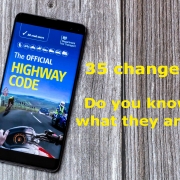
Did you know?

Here is a link to the main changes to the Highway Code

Datim Ltd introduces a robust driver risk management programme

Background

DATIM is a long-established, growing, family business, which specialises in architectural Doorsets and Ironmongery for commercial, education, Government, healthcare, industrial, leisure and retail projects.

Challenges Faced

The company has a number of high-mileage drivers and DATIM recognises that driving is a high-risk activity.

Requirement

As a responsible employer, DATIM wanted to do everything possible to keep their staff safe on the road.

How We Helped

The company’s vehicle fleet is managed by MDEL Fleet management. Working in partnership with them Adrian has helped DATIM to introduce a driver risk management programme, which included:

•          An audit on the businesses driving activities

•          Production of a risk assessment and driver safety policy

•          Help with the programme’s roll-out

•          Provision of a Driver Safety Handbook

Adrian has also delivered his Line Manager course to DATIM’s senior management team in Chesterfield. The half-day workshop has been designed to explain Line Manager responsibilities for managing driver safety in the workplace. Car and van drivers at DATIM are also undergoing on-line driver training.

DATIM’s Managing Director Garry Hughes said:

“Adrian’s knowledge of driver risk management is extensive. He guided us through every step of the process, from design to implementation. The Line manager workshops were essential as we know how important it is that everyone understands their responsibilities when it comes to driver safety. Adrian’s course has given us the knowledge and confidence to ensure our driver risk management programme is properly managed. He also went the extra mile by delivering an online webinar to one of the managers who was poorly on the day of training which made sure no one missed out.”

Don’t get caught the ‘morning after’

Even though we are in challenging times, we can’t escape the fact that we are heading into office party season and inevitably, alcohol will play a part at such events.

Most people are responsible and accept that drinking and driving is a definite no no, however, there is a small sector of society who for one reason or another will take to the road and drive after having consumed alcohol, I’m not going to attempt to discuss this, but I am more concerned about the person who ‘might’ drink and drive through lack of knowledge.

Many Police forces have already announced the commencement of their drink-drive campaign and we can expect to see the Police conducting breath tests in the morning, this catches out the unsuspecting driver who was out the night before drinking and did the sensible thing and made alternative arrangements to get home, however, they perhaps didn’t consider the amount of alcohol being consumed and the possibility of being over the limit the following day!

To help avoid getting into the ‘morning after’ scenario, we need to understand drinks as units of alcohol consumed, not the strength of the drink. That’s because it takes the body on average one hour to get rid of one unit of alcohol, it’s a process that we can’t speed up.

Before we go too far into this blog, there is a question we always get asked, ‘how much can I drink before I go over the limit’? This is an impossible question to answer because we are all different, and for some, even a small amount of alcohol impairs their ability to drive safely, even though they may not be over the limit, so, if you are going to drive, absolutely no alcohol is by far the best policy.

So then, how do we know how many units of alcohol are in a drink? That’s simple for bottled and canned drinks, just look at the label on the back, there is a symbol of a bottle or can and a value, if it showed say 1.5, that’s how many units of alcohol the drink contains, meaning that it will take our body one and a half hours to get rid of all that alcohol, remember, one unit per hour.

If we are consuming drinks served in a glass, then it is all about volume and strength. There is a very simple formula to work out how many units, you take the drink volume in ml, then multiply it by the % strength, then divide by 1000. Let’s look at an example, a medium wine (175ml) at 12.5% strength. The calculation is 175 X 12.5 = 2187.5 If you divide this by 1000, you get 2.1875, round this up to 2.2, this is how many units of alcohol that drink contains.

Here are some typical drinks and units:

  • Pint of ordinary strength beer – 2 units
  • Small wine – 1.5 units
  • Standard wine – 2.2 units
  • Large wine – 3.1 units
  • Spirit (25ml measure) – 1 unit

Here’s a shocker – three large glasses of wine is actually the entire bottle, and at an average strength of 13%, that’s 9.75 units, nine and three-quarter hours to get rid of!

Working on the assumption that we may have more than one drink, we would need to tot up all the units consumed over the session, then convert units to hours, so, if you’ve had say 9 units, not a heavy session, it would take 9 hours to get rid of the alcohol!

Although your body will begin to process alcohol straight away, well, usually within 30 minutes or so, it’s likely that you will be adding units faster than you are getting rid of them and it’s impossible to keep tabs and work out when all of the alcohol will have left your body, so, the best option is to calculate the total units in hours, and wok forward in time from when you finished your last drink.

If we take our 9 units as an example, and say we finished drinking at 11:30 pm, around 8:30 the next morning we can safely assume all the alcohol will have gone.

Here are some poignant questions though; what if you drank more, far more, and finished later? And, you had to drive to work the next morning? Is it possible you could still be over the drink-drive limit? If you got pulled in for a spot check by the Police, you might just find the answer to that question the hard way!

The penalties are tough:

Being in charge of a vehicle while above the legal limit or unfit through drink

You may get:

  • 3 months’ imprisonment
  • up to £2,500 fine
  • a possible driving ban

Driving or attempting to drive while above the legal limit or unfit through drink

You may get:

  • 6 months’ imprisonment
  • an unlimited fine
  • a driving ban for at least 1 year (3 years if convicted twice in 10 years)

Setting the penalties aside, drink-related collisions have an immense impact on society, they devastate lives in an unimaginable way, so please, if you do like a drink, think about the morning after, you now know how to work out when it will be safe for you to drive, doing the maths will enable you to work out when to stop drinking.

Business leaders, please inform your staff about the dangers of drinking and driving and in particular, the morning after scenario and, if you are interested in making sure your staff know about this kind of thing, and a whole load of other driver safety topics, could I tempt you to take a look at my driver training courses, especially the online options, here is a LINK to my training page.

Happy Christmas everyone, stay safe out there.
Top tips for supporting BRAKE Road safety Week

Today, Monday 15th November, marks a very important day in our road safety calendar, it’s BRAKE’s National Road Safety Week, the theme being ROAD SAFETY HEROES, celebrating the heroic work of road safety professionals, and explaining how we can all play a part in making journeys safer for everyone.

We’ve also just seen the conclusion of COP26, where 200+ world leaders have come together to discuss and plan how to deal with major environmental challenges.

I thought to mark day 1 of road safety week I’d take a look at how as individuals and businesses, we can become ‘road safety heroes’, and in doing so, lower our carbon footprint with some simple driving strategies, plus some hints and tips to make for safer, smoother and therefore more environmentally friendly driving.

I suppose the first thing is to consider is whether the journey by vehicle is needed in the first instance and if it is, are there more sustainable and healthier ways of traveling, walking or cycling for example?

Assuming the journey by vehicle is necessary, let’s look at some fuel-efficient driving tips:

  • Don’t carry unnecessary weight – empty the boot of heavy unneeded items, remove the roof rack/box or cycle carrier, drag from these increases fuel consumption. Do you really need to fill up the tank when say half-full will be sufficient for your needs, why carry that extra weight around?

  • Vehicle fully fit – vehicles that are not regularly serviced will be less fuel-efficient and less safe too. Are your tyres up to scratch, inflated correctly and have as an absolute minimum, 1.6mm of tread across the central three-quarter band? If not, you could be breaking the law and safety will be compromised.

  • Snow can be lovely but – remove snow from your vehicle, including the roof, the snow might slip and impair your vision, the extra weight will consume more fuel too.

  • Watch your speed – we all know that speed limits are not targets, so consider reducing speed where you can. A recent study showed that by limiting your overall speed to no more than 60mph saved 10% of fuel. The less fuel you use the lower your carbon footprint. And guess what, reducing speed has a massive safety benefit!

  • Keep your distance – in driving, time and space are everything. Plenty of space between you and the vehicle in front means that you are less likely to have to keep jabbing the brakes, and, if the vehicle in front stops suddenly, you can stop calmly. If you can’t orchestrate space, you need time, slowing down buys valuable time!

  • Slow to flow – whenever you can, plan to stop but aim to keep going if it is safe. At a roundabout for example, there’s no point in rushing up to a stop, then pulling off again. Better to reduce speed on the approach, making the final approach at a speed that will enable you to spot that gap, and flow safely without actually stopping, it’s smoother, more fuel-efficient and much safer for everyone.
  • See and be seen – when you are driving, it’s easy to forget that others may not have seen you, so, lights on whenever visibility gets poor, don’t forget the daytime running lights on your vehicle work only on the front, the back is in darkness, and, in daytime fog, your auto-on lights may not turn on, you will need to switch them on manually.

  • Vulnerable road users – please look out for cyclists and pedestrians, they are among our most vulnerable of road users. I know, I’m going to get comments about pedestrians and cyclists not helping themselves, especially when it comes to visibility issues, but, as a responsible road user I’m sure you would want to take the lead, just in case others don’t. Did you know that the Highway Code has been changed, there is now a hierarchy of road users listed and new rules that protect pedestrians that are crossing roads – do you know what the new rules are?
  • Don’t drive while fatigued – Lack of sleep can make you less alert and affect your coordination, judgement, and reaction time while driving. The most common times for drivers with normal sleep patterns to fall asleep at the wheel are early morning (2am-6am) and early afternoon (2pm-4pm). These times are when the body clock reaches a natural dip, causing drowsiness and reduced concentration.
  • Drugs and alcohol – not a great mix when it comes to driving. Make sure that any medication you are taking will not impact on your ability to drive safely, ask you GP, and if you like the odd drink or two, please consider the morning after affect, this is where you consume alcohol the night before that might still be in your blood stream the next morning!

The above is not a definitive list, but some small changes that we can all do to contribute towards supporting BRAKE Road Safety Week, and hopefully beyond as these techniques become our default behaviour.

Courtesy and kindness costs nothing

November 13th marks World Kindness Day – a day that promotes being kind to one an another and yourselves.

But how does being kind relate to road safety?

You only have to Google: ‘road rage,’ to see that ‘being kind,’ doesn’t always come into play.

The internet is awash with coverage on road rage incidents with the media telling us that it’s on the rise. This Sky News article from this time last year – is just one example.

But what causes road rage and why can’t drivers just ‘be kind?’ Often any one of the following can be enough to trigger someone leading to an angry exchange or road rage incident.

  • Tailgating
  • Talking on a mobile
  • Driving too slow or too quickly
  • Undercutting or staying in the middle lane

If you’re unfortunate enough to see examples of poor or dangerous driving that directly impacts on you as a motorist, how can you keep your calm to avoid becoming a statistic? Here are just a few ideas:

  • Try and leave plenty of time for your journey – if you’re running late and under pressure, you’re more likely to lose your cool
  • Avoid eye to eye contact with a driver who’s angry or aggressive as that can sometimes ignite a situation
  • Nobody’s perfect and we all make mistakes from time to time. If you do something wrong, a simple ‘sorry’ and acknowledgement of your error goes a long way to defusing a situation
  • If someone’s annoyed you, here’s a challenge for you, say out loud, “this is just an ordinary person, just like me, and I’m sure that was a genuine mistake on their part”, this will help you to not overreact, being the bigger person and taking a responsible and forgiving approach will make you feel good too.

Simple things that can often get forgotten when you’re in the heat of the moment.

The Royal Society for the Prevention of Accidents actually created a factsheet back in 2017 which still resonates today, I’d recommend you take a look and share with anyone who drives as part of their work.

Being kind – can take all forms – none more so than when you’re behind the wheel and this can be a real challenge for businesses, especially those who have staff who spend a lot of time on the road. Imagine the reputational damage that can be done if a team member in a liveried vehicle has a pop at a member of the public!, would this be damaging for your brand? so, what do you have in place to manage this, and the many other safety-related areas? 

For more information on how I can help keep your staff safe on the roads, and protect the businesses reputation and brand, please visit my website to discover how I can help you with your driver risk management and driver training.

If would like further information, please contact Tamsin at Legs PR on 07971 484340 or email hello@legspr.agency

Managing driver safety in the workplace – do we really have to do this?

In my line of work I often hear; ‘I didn’t realise it was a legal requirement to manage driver safety’ or, ‘how come I’ve not heard of this before’?

To be honest, I’m never surprised when I hear this and as a business, it’s okay to not know this stuff, after all, ‘we don’t know what we don’t know’, right? In fact, in one sense, that’s good, probably because nothing bad has happened insofar as a serious road traffic accident, therefore you won’t have been challenged to demonstrate the appropriate due diligence that’s required under the Health & Safety at Work Act.

Just think for one moment and ask, if we were to suffer a serious incident involving someone who drives on behalf of the business, and we were under investigation right now, can we say with 100% certainty that everything is in place that would be required of us to manage driver safety? Not sure, here is a link to my media page, watch the 6-minute video, ‘When things go wrong’, imagine you in the interview seat!

I’m guessing for many their thoughts would go along the lines of, what are we supposed to have in place, is everything up to date, who’s responsibility is this in our business? The last question is easy for me to answer, it’s the owner of the business, the controlling mind/s of that business in other will be held accountable and ultimately, responsible, so, it’s very important that such people are confident of their processes and practices to manage driver safety are firmly in place and more importantly, part of the business day to day safety culture.

Just to focus the mind a little further, it might be worth exploring what the consequences are when things go wrong, well, apart from the obvious concern for the safety and wellbeing of staff that is. There are two potential nasties that could appear. The first is a fine for failing to meet duty of care obligations under health and safety law, typically 20% of the businesses turnover, then if it’s a really serious incident, the business owner could face Corporate Manslaughter or Gross Negligence Manslaughter charges which are likely to result in a custodial sentence.

Incidents involving crashes, including those that involve people driving as part of their work rarely make the news headlines, but, you don’t have to search very far before you can find examples of where things went horribly wrong, for instance, this link will take you to an article about a company that in 2020 were fined £750,000, all because they didn’t have a robust driver risk management programme in place and as a result, two members of their staff lost their lives.

So where is it stated then that driver safety must be managed? – good question, well, it’s the Health & Safety Executive (HSE) that issue guidelines that must be followed, and here is a link in those guidelines to the legal bit. 

If you have everything in place that’s in these guidelines, great, you will certainly be able to sleep at night and if necessary, demonstrate appropriate due diligence. If however you haven’t, what you do next will be down to your attitude towards risk. Some might simply say, ‘don’t think anything bad will happen to us’ and carry on a usual, hopefully they won’t end up in Court like the company that got that massive fine!

Alternatively, you might have a low-risk threshold and want to do everything you can, not just as a responsible employer, but to meet your health and safety requirements. A great starting point is to study the HSE guidelines, however, if you would like some help in navigating your way through towards introducing a driver risk management programme within your business, could I tempt you to get in touch for a no-obligation, no pressure chat? Here is a link to my contact form.

Prompt PC see the value in driver risk management

Background

Prompt PC is one of Staffordshire’s leading IT security and Microsoft 365 specialists. They have a small team of engineers who visit clients on site using company vehicles.

Challenges Faced

The business owner Andrew Eardley wanted to ensure that their team was as safe as possible on the roads.

Requirement

It’s a busy team and they needed training that could fit in with their busy schedule. Prompt PC worked with Adrian Hide Consultancy to discuss their requirements and decided that the on-line eco-saving driving course would be the best fit for their requirements.

How We Helped

Prompt PC owner Andrew Eardley said: “As a responsible employer I wanted to make sure that staff had the right training to ensure they were as safe as possible on the roads. Working with Adrian has been great. He’s clearly an expert in his field and gave us the advice needed to make sure the training fitted what we needed.  As it was on-line, it was very convenient for the team. They’ve all completed it now, have enjoyed it, learnt lots and are more aware. I’m really pleased and assured that as an employer I’ve done all I can to make sure that our drivers have had the right training for when they’re out on company business. I wouldn’t hesitate to recommend the training or Adrian’s support.”

Get in touch

Together, we can make the roads safer for everyone

Call us on 07973 337 251
Email us at hello@adrianhideconsultancy.co.uk

Safer Driving Academy is the training division of Adrian Hide Consultancy

Get in touch

Together, we can make the roads safer for everyone

Call us on 07973 337 251
Email us at hello@adrianhideconsultancy.co.uk

Contact us Privacy Policy

Safer Driving Academy is the training division of Adrian Hide Consultancy

© Copyright Adrian Hide Consultancy | Safer Driving Academy is the training division of Adrian Hide Consultancy | Website by Clyq

Contact us Privacy Policy

© Copyright Adrian Hide Consultancy | Safer Driving Academy is the training division of Adrian Hide Consultancy | Website by Clyq